UV textile painting
Backdrops
Room 01 · Catalogued May 2026 · Text Lode Vercammen
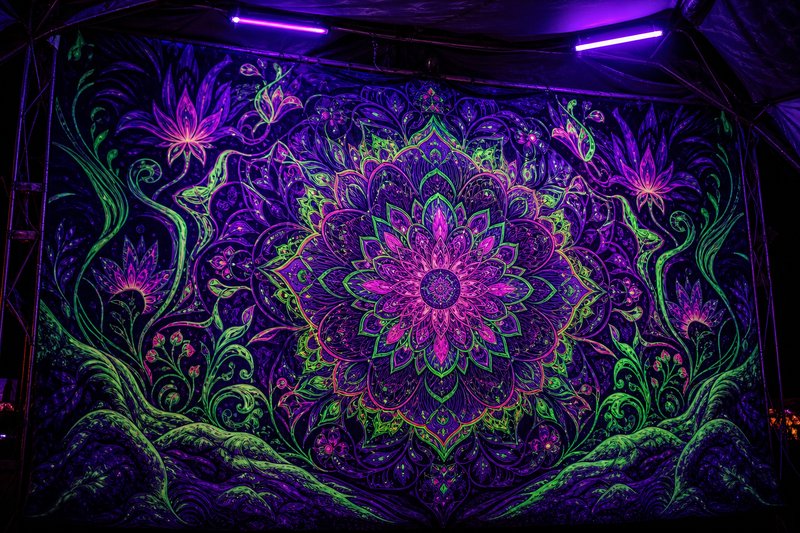
A UV backdrop is a painting designed for darkness. Stretched behind a DJ booth or along the edge of a dance floor, it looks unremarkable in daylight: pale fabric, chalky colours. Switch on a blacklight and the same cloth turns into a wall of saturated, glowing imagery. For three decades this transformation has been the signature effect of psytrance decoration, and the painted backdrop remains its most collected, traded and photographed object.
How fluorescent paint actually works
Fluorescence is not a trick of brightness. Fluorescent pigments absorb ultraviolet radiation, in the 365 to 400 nanometre range that so-called blacklight tubes emit, and re-emit that energy at longer, visible wavelengths. The physicist George Stokes described the effect in 1852, which is why the wavelength difference is called the Stokes shift. In practical terms: the painting receives light the eye barely registers and returns light the eye sees vividly, so it appears to glow while its surroundings stay dark.
Modern daylight-fluorescent pigments trace back to the Switzer brothers, whose experiments in the 1930s led to the Day-Glo colour range. Decor painters use acrylics carrying those pigment families, sometimes layered over a base of ordinary matte black or deep blue that swallows stray light and pushes the fluorescent passages forward.
Fabric, scale and technique
Most backdrops are painted on cotton, canvas or stretch lycra. Cotton takes brushwork well and folds small for transport. Lycra can be tensioned into curved sails and geometric frames, which suits abstract designs. Sizes run from one-metre booth panels to pieces of ten by six metres and larger for main stages, painted on a floor over days or weeks.
The imagery has recognisable families: mandala and yantra geometry, flora and fungi, cosmic scenes, deities and spirit figures, and dense abstract patterning that reads differently up close and from across the floor. Fine white or pale-yellow linework is common because those tones fluoresce hardest, giving the crisp electric edge the style is known for.
Rigging a soft gallery
A backdrop only works if it hangs well. Crews sew webbing loops or eyelets along the top edge, then tension the piece between scaffolding, trees or a stage frame with elastic cord, so wind passes through the site without tearing anything. Placement follows the light plan: every painted surface needs a UV source within throw distance, usually 400-watt UV floods or rows of LED blacklight bars for larger walls.
Care is mundane but real. Fluorescent pigments fade with prolonged sunlight exposure, so pieces are rigged after sunset where possible and stored rolled, not folded, to spare the paint layer. A well-kept backdrop tours for a decade.
A short history of the painted party wall
The lineage starts on the beaches of Goa, where the parties of the late 1980s decorated with whatever glowed: painted bedsheets, fluorescent tape, statues dressed in dayglo cloth. When the music travelled to Europe in the early 1990s, the decoration professionalised with it. Crews formed around painters who could deliver large fluorescent work reliably, and by the 2000s a recognisable circuit of decor collectives supplied festivals from Portugal to Japan, each with a house style dancers could identify at a glance.
Two things changed in the decades since. Blacklight hardware moved from fragile fluorescent tubes to bright, cheap UV LED fixtures, which let crews light bigger walls with less power. And the internet gave the form a memory: backdrops that once existed only for the crowd in front of them now circulate as photographs, get credited to their painters and are bought by collectors who never saw them hung. The craft did not change its materials much. It gained an audience beyond the dance floor.
Why backdrops matter to the culture
The backdrop is the most portable form of psychedelic art. It carries a complete artwork into any venue, needs no pedestal and no frame, and disappears into a tube bag when the weekend ends. Painters build reputations on them, party organisers hire crews on the strength of them, and dancers navigate a festival by them. Alongside the string constructions that shape the space overhead and the projected visuals layered on top, the painted cloth remains the foundation of the psychedelic dance floor.
Frequently Asked Questions
What material is a UV backdrop painted on?
Mostly cotton, heavy canvas or stretch lycra. Cotton and canvas suit detailed brushwork and roll up for transport; lycra is tensioned into shaped sails and frames for abstract geometric work. All of them are painted with acrylics carrying daylight-fluorescent pigments.
What kind of light makes a backdrop glow?
Ultraviolet light in the UV-A range, roughly 365 to 400 nanometres. Crews use UV flood lamps, fluorescent blacklight tubes or LED blacklight bars. The pigments absorb that near-invisible light and re-emit it as visible colour, which is why the painting glows while the wall behind it stays dark.
Do fluorescent paints fade over time?
Yes, mainly through sunlight. Prolonged UV exposure in daylight breaks the pigments down, so touring pieces are rigged after dark where possible and stored rolled in tubes. Kept that way, a backdrop stays vivid through years of regular use.
How big is a typical festival backdrop?
Booth panels start around one by one metre. Standard dance floor pieces run three to six metres wide, and main-stage walls reach ten by six metres or more, usually painted flat on a floor over several days and hung as a set of joined panels.
Can a backdrop be displayed at home?
Easily. Many artists sell smaller tapestry-format pieces exactly for that, and a single compact UV LED bar is enough to light one wall. In daylight the piece reads as a pale painting; under the lamp it shows its intended palette.