01
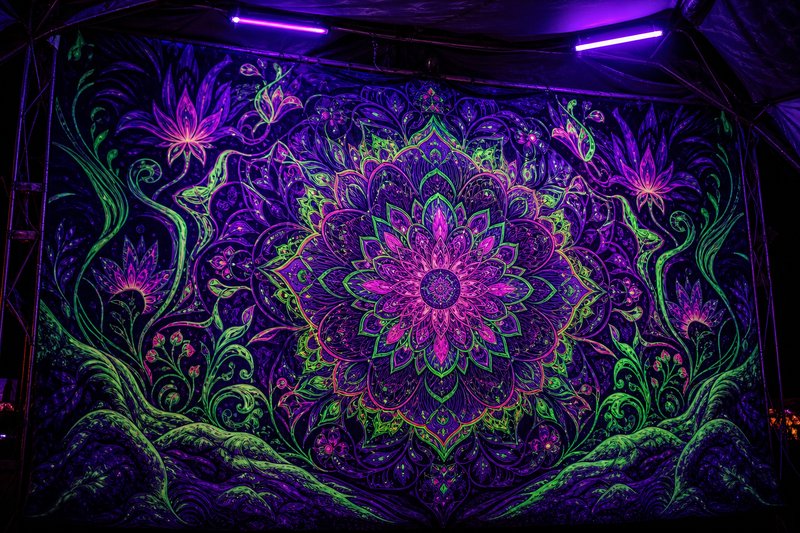
UV textile painting
Backdrops
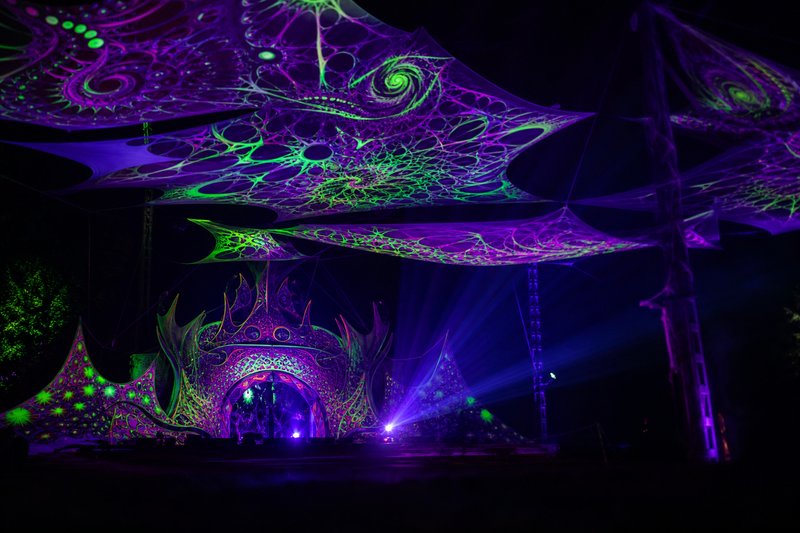
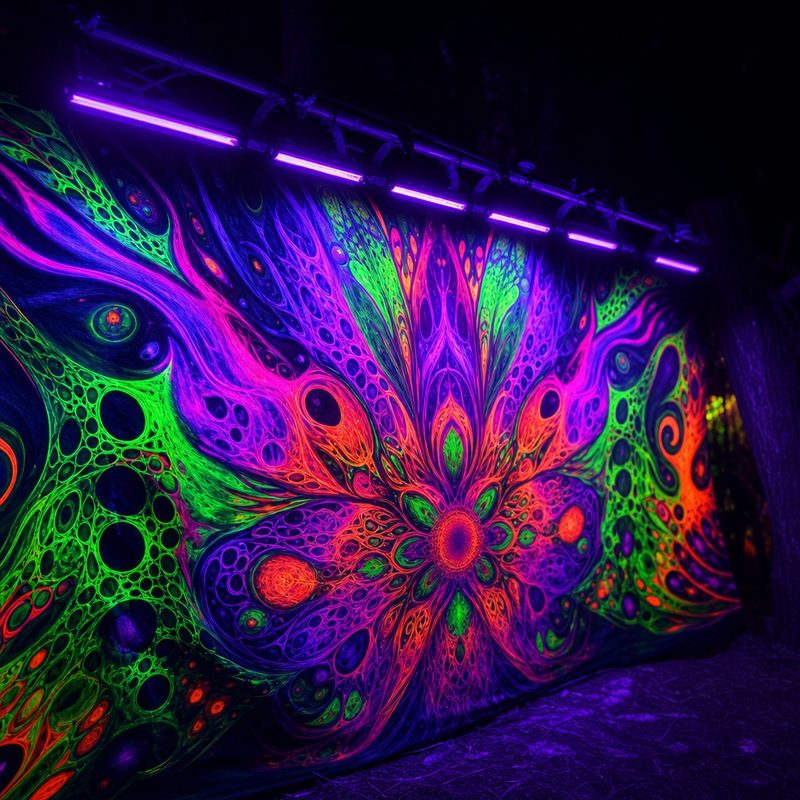
Painted fabric panels that line walls and ceilings at psychedelic events - most of them fluorescent, all of them built to glow under blacklight.
Enter room 01Psychedelic Art · Festival Visual Culture
PsyGarden documents the visual side of psychedelic festival culture: UV-reactive backdrops, string-art installations, visionary painting and projected visuals - the craft, the history and the techniques that turn a night-time clearing into another world.
Long before LED walls took over the main stage, festival decor was sewn, stretched and painted by hand. Fluorescent pigments, blacklight tubes and kilometres of knotted cord built environments that respond to ultraviolet light in ways daylight never reveals.
These pages trace that craft, collection by collection: the painted backdrops, the string constructions, the visionary canvases and the projected visuals that together turn a night-time clearing into another world.
The psychedelic aesthetic did not appear out of nowhere. It runs from the poster shops of 1960s San Francisco through the beach parties of Goa and into the European festival circuit, where a loose network of painters, builders and projection artists still produces most of what dancers see after dark. Their work rarely reaches conventional galleries. It hangs from scaffolding, glows for one weekend and disappears into a transport crate on Monday morning.
That impermanence is exactly why documentation matters. A painted backdrop can outlast twenty parties and still never be photographed properly. A string installation exists only as long as its tension holds. PsyGarden treats these objects as what they are: applied art with its own history, techniques and standards of craft.
Writing about psychedelic culture tends to drift toward the cosmic. This site takes the opposite approach. A backdrop is a painting with rigging loops; the interesting questions are which pigments survive touring, why fine pale linework glows harder than solid fill, and how a crew tensions six metres of painted cotton against wind. A string canopy is applied geometry; the interesting questions are about ruled surfaces, anchor loads and crossing order. Treating the objects concretely does not shrink them. It is how every serious craft gets its history written.
The same rule applies to people. The scene runs on named crews and working artists - painters who tour their canvases for decades, riggers who can hang a hectare of shade cloth in a storm. Where the record supports it, articles name techniques after the people who developed them and periods after the parties that defined them.
The material is organised the way a decor crew would organise a truck. Backdrops covers painted fabric and the fluorescent pigments that make it glow. 3D Constructions looks at string art and suspended geometry. Paintings follows the visionary canvas tradition from the Vienna School to live painting stages. Visuals & Digital Art takes on the projected layer, from 1960s liquid light shows to modern VJ software.
Each section explains the techniques, the materials and the context. No prior knowledge is assumed, and no dress code applies.
Details of the craft, plate by plate

Four rooms, one continuous tradition
UV textile painting
Painted fabric panels that line walls and ceilings at psychedelic events - most of them fluorescent, all of them built to glow under blacklight.
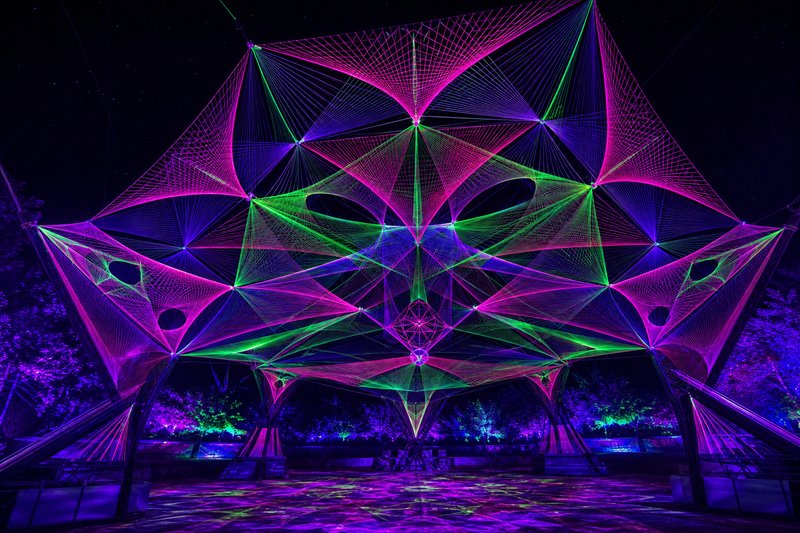
Enter room 01String art & installations
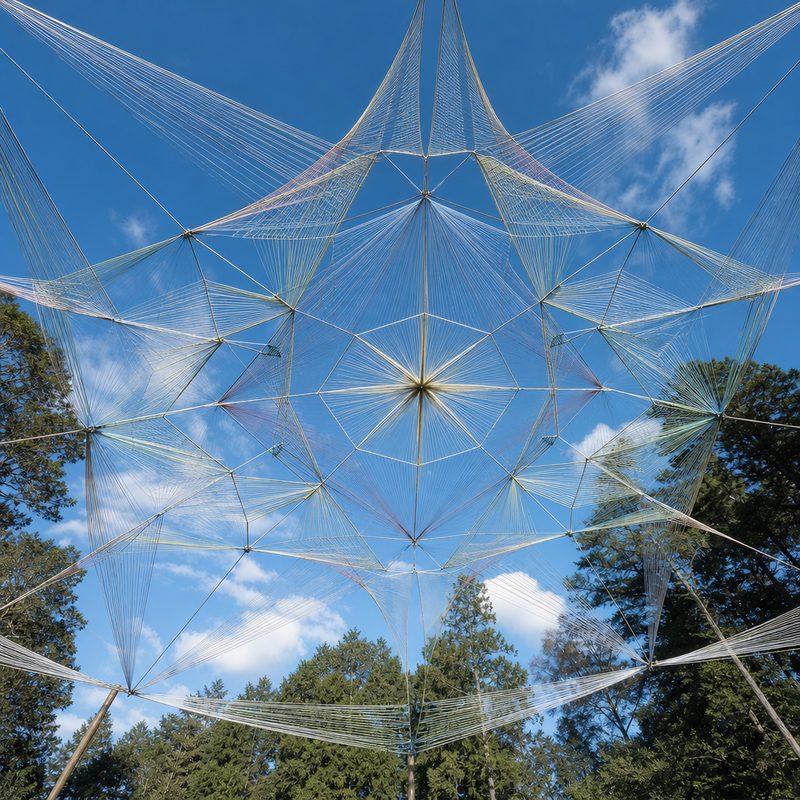
Geometric string sculptures and suspended cord canopies that shape the dance floor in three dimensions.
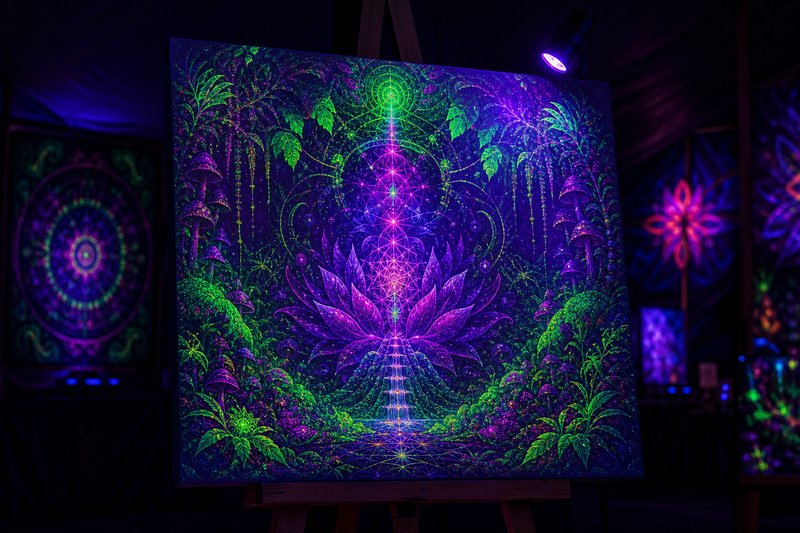
Enter room 02Visionary canvas
Visionary and psychedelic painting - the gallery wing of a culture usually experienced at 140 BPM.
Enter room 03Projection & digital
VJ sets, projection mapping and digitally-native psychedelic art, from 1960s liquid light shows to real-time generative systems.
Enter room 04Six decades from light show to projection mapping
Overhead projectors, coloured oil and dye turned ballroom walls into moving paintings and set the template for art made to be danced in front of.
UV-reactive paint and blacklight tubes became cheap enough to travel, moving glow art out of fixed installations and into clubs, squats and warehouses.
Painted cloth strung between palm trees defined the first true party deco, and the style travelled home in backpacks across Europe, Israel and Japan.
Dedicated crews began treating backdrops, string canopies and sculpted totems as one continuous stage-design craft rather than loose decoration.
Gallery scripts and forum boards let crews publish photo archives between festivals, turning builds that lasted one weekend into a documented tradition.
Projection mapping and LED brought generative visuals to the main stage, while hand-painted UV work holds its place as the scene's signature craft.
The vocabulary that hangs beside the work
It is the applied visual art made for psychedelic music events: painted UV backdrops, string and fabric installations, visionary paintings and projected visuals. The style favours saturated fluorescent colour, geometric pattern and imagery drawn from nature, mythology and altered perception. Most of it is built to be experienced under blacklight at night.
Fluorescent pigments absorb ultraviolet light, which is mostly invisible to the eye, and re-emit it as visible colour. Under a blacklight tube a UV-reactive painting appears to glow from within, while ordinary pigments around it stay dark. This effect, called the Stokes shift, is the technical backbone of psytrance decor.
Its roots sit in 1960s psychedelic poster art from San Francisco and London, the visionary painting tradition around Ernst Fuchs and later Alex Grey, and the Goa party culture that moved from India to Europe in the early 1990s. Festival decor crews merged those influences into the UV-heavy look seen today.
No. Visionary painting hangs in dedicated galleries and museums, UV installations appear in clubs, planetariums and immersive exhibitions, and many decor artists sell canvases, prints and tapestries year-round. The festival is the tradition's main stage, but not its only venue.
Stage design centres on the DJ booth and main structure; decor covers the whole environment - backdrops on the fences, string work over the dance floor, lighting, shrines and chill spaces. At larger festivals separate crews handle each, coordinated so the site reads as one continuous visual world.